
Trusted ERP Solutions Provider To Small, Medium and Large Enterprises

WAREHOUSE MANAGEMENT SYSTEM
Saeeda Riaz
Saeeda Riaz – Partner, AGN IT Services LLC | Strategic IT Partner of 10+ Enterprises
I hope you find this blog post insightful. If you’d like our team to handle technology in your business and bring the best ROI, click here.
ERP for Electronics Manufacturing: Streamline Complex Supply Chains

Why Electronics Manufacturing Needs ERP

The electronics industry is revolutionizing. From smartphones and laptops to circuit boards and semiconductors, new products hit the market almost every week. To stay competitive, manufacturers must handle fast-changing designs, complex supply chains, and strict quality standards—all while keeping costs under control.

This is why many companies turn to ERP for electronics manufacturing. An ERP system acts like the command center of your business, connecting production, inventory, sales, and finance into one streamlined platform. Instead of relying on separate tools for each department, ERP brings everything together, giving manufacturers complete visibility and control.

In this blog, we’ll explore how an ERP system for manufacturing companies can help electronics manufacturers streamline supply chains, improve efficiency, and stay ahead of the competition.

Challenges in Electronics Manufacturing

Electronics manufacturing is one of the most demanding industries in terms of precision and speed. Some common challenges include:

  • Complex supply chains: Sourcing components from multiple suppliers worldwide.
  • Frequent design changes: Products quickly become outdated, requiring agility in production.
  • Inventory management: Balancing thousands of small, high-value parts.
  • Quality assurance: Strict compliance with international safety and quality standards.
  • High customer expectations: Demand for fast delivery and reliable products.

Without the right tools, these challenges can result in delays, rising costs, and dissatisfied customers.

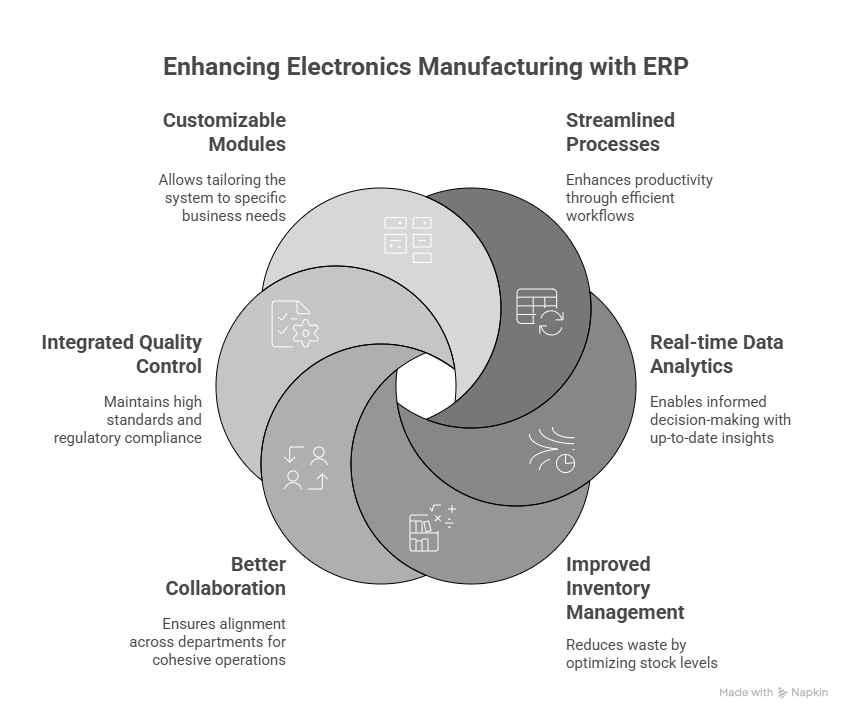
Enhancing Electronics Manufacturing with ERP

How ERP Solves Electronics Manufacturing Challenges

Implementing ERP for electronics manufacturing provides solutions that address industry-specific needs:

  • Supply Chain Visibility: Real-time tracking of components, suppliers, and logistics ensures smooth production.
  • Product Lifecycle Management: ERP supports fast-changing designs and helps manage revisions efficiently.
  • Inventory Optimization: Keeps stock levels balanced, preventing both shortages and excess inventory.
  • Quality Control: Ensures strict compliance with industry standards like ISO and RoHS.
  • Cost Tracking: Tracks raw materials, labor, and overhead to ensure profitability.
  • Data-Driven Insights: Provides analytics to improve forecasting and production planning.
Enhancing Electronics Manufacturing with ERP

Key Features of ERP for Electronics Manufacturing

1. Advanced Inventory Management

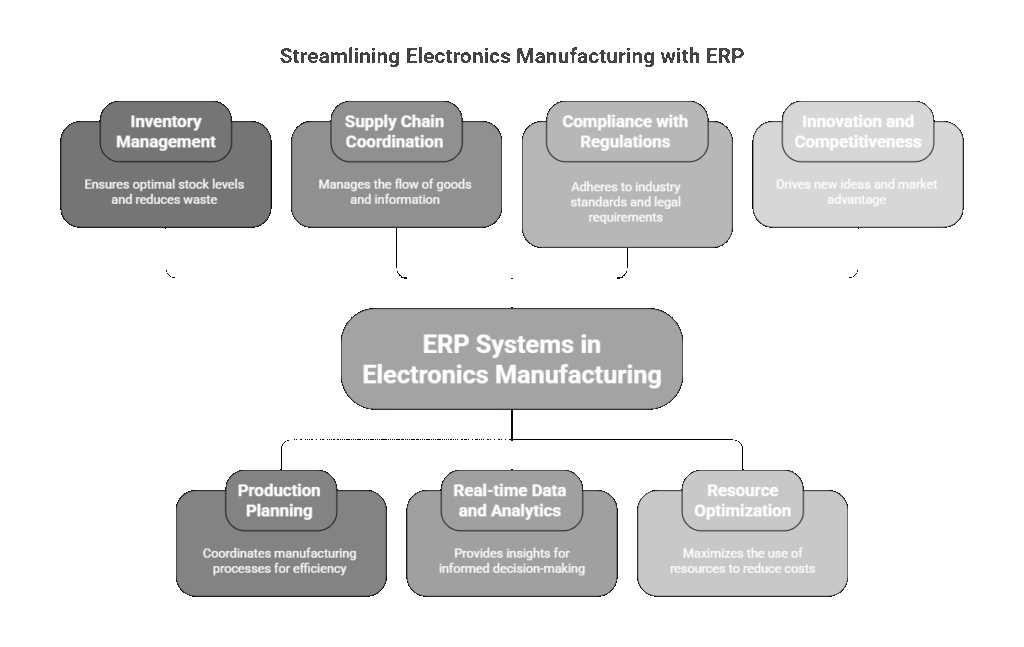
Electronics manufacturers handle thousands of tiny, expensive parts. ERP helps track each item, prevent losses, and automate reorders when stock runs low.

2. Supply Chain Coordination

ERP connects multiple suppliers and logistics providers into one system, ensuring timely component deliveries and reducing delays.

3. Production Planning & Scheduling

Manufacturers can schedule production runs, allocate resources, and minimize downtime using ERP’s smart planning tools.

4. Quality & Compliance Management

ERP ensures that every product meets international standards and maintains proper documentation for audits.

5. Financial Integration

From procurement to sales, ERP integrates finance, making cost analysis and budgeting easier and more accurate.

Top ERP Systems for Electronics Manufacturers in 2025

  • SAP S/4HANA is a powerful solution for large-scale electronics manufacturers.
  • Microsoft Dynamics 365 combines ERP and CRM with AI-driven insights.
  • Odoo is a flexible and cost-effective solution for small to mid-sized electronics businesses.
  • Oracle NetSuite is a cloud-based ERP ideal for global supply chains.
  • Infor CloudSuite Industrial is tailored for complex manufacturing industries.

Best Practices for Implementing ERP in Electronics Manufacturing

  • Map your needs clearly: Identify key challenges like supply chain or inventory.
  • Choose the right ERP Pick a system that matches your company’s size and complexity.
  • Start with core modules: Focus on supply chain, production, and inventory before expanding.
  • Train your team: Successful ERP adoption depends on user knowledge.
  • Work with experts: Partner with vendors who understand electronics manufacturing.
Conclusion

Electronics manufacturing is fast, complex, and competitive. By adopting an ERP for electronics manufacturing, businesses gain control over supply chains, improve efficiency, and ensure product quality. The right ERP system for manufacturing companies doesn’t just manage data, it transforms it into insights that keep production moving smoothly and profitably.

ERP integrates supply chain, production, inventory, and finance, helping electronics manufacturers manage complex operations efficiently.

SAP, Microsoft Dynamics, Oracle NetSuite, and Odoo are popular choices, depending on company size and needs.

ERP provides real-time visibility, tracks suppliers, and automates logistics, reducing delays and shortages.

Yes. Affordable ERP options like Odoo and Zoho offer scalable solutions without high upfront costs.

Absolutely. ERP ensures products meet international quality and safety standards while maintaining proper documentation.

en_USEnglish