Trusted ERP Solutions Provider To Small, Medium and Large Enterprises

The furniture industry is unique—it blends creativity, craftsmanship, and large-scale production. From sourcing raw wood and upholstery to delivering finished products, manufacturers deal with multiple processes that must align perfectly.
Managing all of this with spreadsheets or standalone systems often leads to inefficiencies, delays, and waste. This is where ERP for furniture manufacturing comes in. An ERP system integrates every stage of the process—procurement, design, production, inventory, sales, and delivery—into one unified platform.
In this blog, we’ll explore how an ERP system for manufacturing companies helps furniture manufacturers streamline operations, cut costs, and deliver products faster and more efficiently.
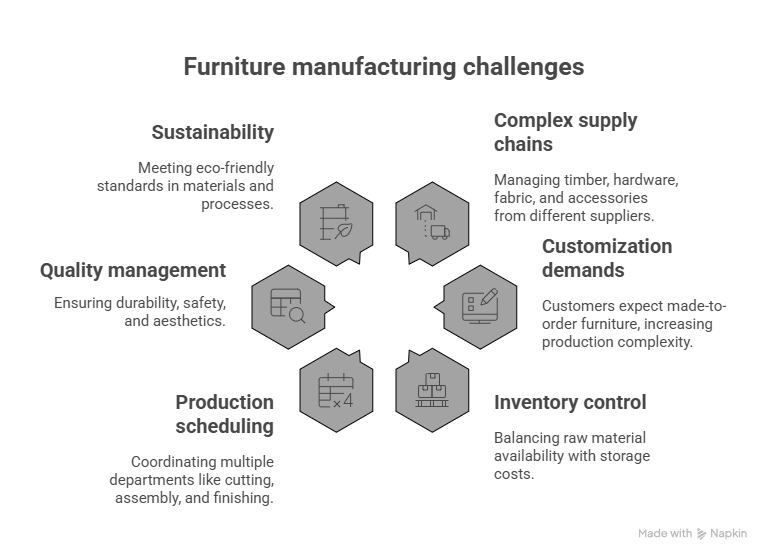
Furniture production faces several unique challenges:
Without ERP, these challenges can create bottlenecks and increase costs.
Implementing ERP for furniture manufacturing provides the following benefits:
ERP helps track wood, fabric, and accessories in real time, preventing material shortages or waste.
ERP schedules tasks, monitors workflows, and reduces downtime on the shop floor.
Handles customer-specific designs, sizes, and finishes while maintaining accuracy.
ERP ensures products meet durability, safety, and design standards.
From raw material suppliers to distributors, ERP keeps the entire supply chain connected. Read more about supply chain ERP
The furniture industry is evolving, with customers demanding customization, faster deliveries, and sustainable practices. By adopting an ERP for furniture manufacturing, businesses gain control over raw materials, streamline production, and ensure quality from start to finish.
The right ERP system for manufacturing companies doesn’t just automate processes—it empowers furniture makers to grow, innovate, and stay ahead in a competitive market.
ERP integrates every step of furniture production, from raw material tracking to final delivery. It ensures accurate inventory, reduces waste, and streamlines workflows. By centralizing operations, manufacturers can boost efficiency, cut costs, and improve product quality, making ERP an essential tool for modern furniture businesses.
For smaller furniture manufacturers, affordable and flexible solutions like Odoo and Zoho ERP are ideal. They offer easy-to-use modules for production, inventory, and sales. These systems are scalable, meaning companies can start with basic features and expand as they grow, without heavy upfront investments or complexity.
Yes. ERP is designed to manage customization requests like different sizes, finishes, and designs. It ensures accurate material allocation, cost calculation, and timely order processing. This makes it easier for furniture manufacturers to meet customer demands while maintaining efficiency and profitability, even with frequent product variations.
Not at all. While enterprise-level systems like SAP suit large manufacturers, cloud-based ERPs such as Odoo and Zoho are perfect for small and mid-sized furniture makers. These systems are affordable, easy to implement, and customizable, allowing businesses of all sizes to benefit from streamlined processes.
Yes. ERP reduces waste by tracking material usage, optimizing production schedules, and minimizing errors. It also helps companies source eco-friendly materials and maintain compliance with environmental regulations. By making processes more transparent and efficient, ERP enables furniture manufacturers to support sustainability while staying competitive in the market.
Saeeda Riaz
Partner at AGN IT Services LLC | Strategic IT Partner of 10+ Enterprises
Saeeda Riaz is a seasoned IT consultant with over 23 years of experience in delivering innovative technology solutions to businesses across various industries. As the driving force behind a leading IT solutions company, she specializes in digital transformation, business automation, and software development. Her strategic vision and hands-on expertise help organizations streamline operations, enhance efficiency, and stay ahead in the digital landscape.
Connect on LinkedInWhatsApp us